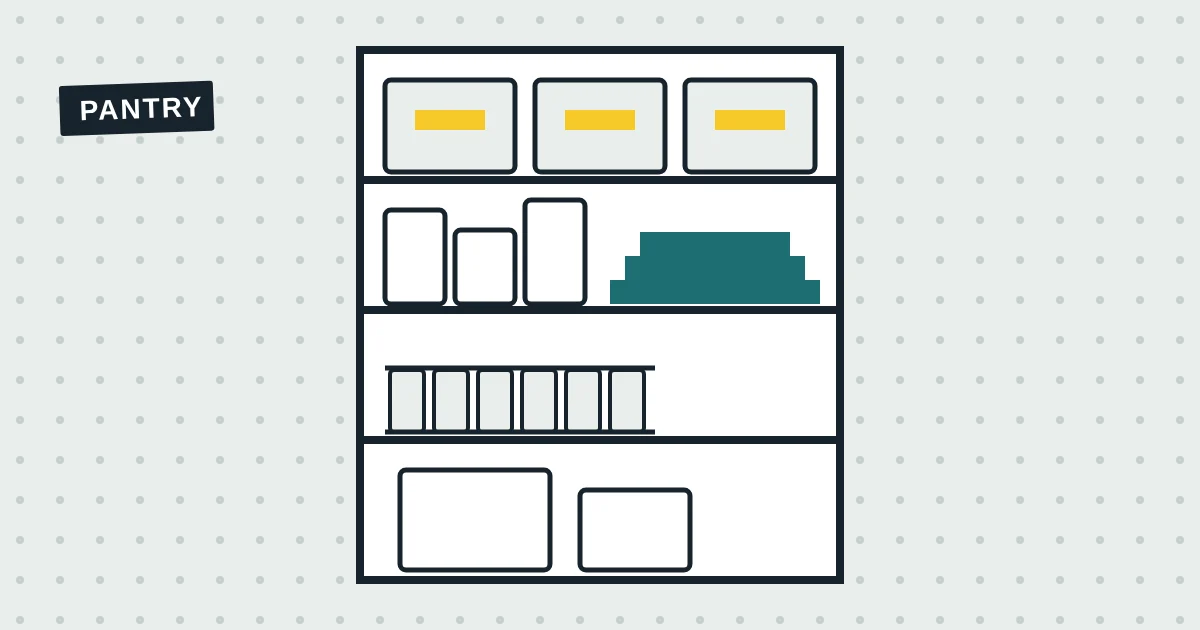
Short answer: empty the pantry, check dates and throw out damaged cans, then zone the shelves: backups on top, daily items at eye level, cans and snacks below, heavy items on the floor. Add a tiered riser, a stackable can rack and clear bins so you can see every label. Keep the pantry away from the stove and the sink.
Step 1: empty it and check dates
Take everything out and group like with like. While it is out, check it against the USDA Food Safety and Inspection Service guidance for shelf-stable foods:
| Item | USDA FSIS guidance |
|---|---|
| High-acid canned food (tomatoes, most fruit, pickles) | Best quality for 12–18 months |
| Low-acid canned food (meats, most soups, corn, beans) | Best quality for 2–5 years |
| Bulging, leaking or swollen cans | Throw out |
| Deep dent on any seam, heavy rust | Throw out |
| Small dent, light surface rust that wipes off | Generally fine |
The same guidance says to store cans and shelf-stable food in a cool, dry place, ideally below 85°F, and never above or beside the stove, under the sink or in a damp garage or basement. If your “pantry” is the cabinet over the stove, move the food and use that cabinet for platters or baking sheets.
Step 2: zone the shelves
- Top shelf: backups and occasional items, in labeled clear bins you can pull down by the handle.
- Eye level: what you use every day: airtight containers for flour, rice, pasta and cereal; a tiered riser for spices and small jars.
- Lower shelf: cans on a stackable rack, snacks in an open bin kids can reach.
- Floor: heavy things such as bottled water, potatoes and onions (in a ventilated basket) and the small appliances you use weekly.
- Door: an over-the-door rack for spices, packets and wraps, if the door clears the shelves.
How many cans fit on your shelf?
Shelf can calculator
Measure one shelf in inches.
The numbers show the problem with deep shelves: you can fit a lot, but you only see the front row. That is why risers and racks matter more than extra space.
Our picks for a small pantry
Affiliate note: some links in this guide go to Amazon. As an Amazon Associate we earn from qualifying purchases, at no extra cost to you. We choose products for fit and specifications, not for the commission.
Holds 36 cans and shows every label; stackable.
Check on AmazonSquare, stackable containers in four sizes.
Check on AmazonExpands from 14 to 27 inches wide.
Check on AmazonShopping on Black Friday? Add it to your Amazon cart now so it is ready when deals start.
How we chose
- We started from the measurements in this guide and looked for products whose listed dimensions fit typical cabinets and closets.
- We favored long-running, widely bought products with a large volume of owner feedback, and read the complaints as closely as the praise.
- We checked each listing on October 16, 2026 for stock and U.S. delivery.
- We have not tested these products ourselves. Our picks are based on specifications, instructions and owner feedback.
Best for cans: Simple Houseware 3-Tier Stackable Can Organizer
A chrome steel rack with three sloped tiers that holds up to 36 cans, so you take from the front and see every label. One of the most popular can racks on Amazon for years.
- Turns a deep shelf of hidden cans into a visible display.
- Racks stack with clips.
- Downside: Too deep for shallow cabinets: the maker says it needs at least 12 inches of depth.
Skip it if your shelves are shallower than 12 inches or shorter than 14 inches.
Check it on AmazonBest for dry goods: Vtopmart Airtight Food Storage Containers (24 pieces)
A set of square, clear containers with side-locking lids and silicone gaskets in four sizes, with labels and a marker. One of the most widely bought pantry container sets on Amazon.
- Square shapes use shelf space better than bags and round jars.
- You can see how much is left.
- Downside: 24 containers is a lot for a very small pantry; measure the shelf height before buying the tall sizes.
Skip it if you mostly cook from cans and jars; risers and a can rack will help more.
Check it on AmazonBest for spices and jars: Dial Industries 3-Tier Expandable Shelf
A low, three-step plastic riser that expands to fit the width of a cabinet and lifts back-row jars into view.
- Back-row items stop disappearing.
- Fits standard 16-ounce cans on the top step.
- Downside: The lower steps are shallow; large jars belong elsewhere.
Skip it if you store mostly tall bottles.
Check it on AmazonAlso worth adding
- Clear bins: Vtopmart stackable clear bins with lids for backups and snacks on the top shelf.
- Turntable: the URALFA 10.5-inch lazy Susan for oils and vinegars in a corner.
- Door rack: the Moforoco 9-tier over-the-door organizer if the door clears your shelves.
- No pantry at all? The VASAGLE 5.1-inch slim rolling cart fits beside the fridge.
10 small pantry ideas
- First in, first out. New purchases go behind older ones.
- Decant only what you open often. Flour, sugar, rice, pasta, cereal. Cans stay in cans.
- Label the shelf, not just the container, so everyone knows where things go back.
- Bins as drawers. On deep shelves, a bin with a handle works like a drawer you pull out.
- Risers at eye level for spices and small jars.
- A can rack on the lower shelf.
- Turntables in corners for bottles.
- One “use first” bin for opened snacks and things near their date.
- Use the door for packets and spices.
- A two-minute check before every grocery trip prevents duplicates.
Frequently asked questions
How do I organize a small pantry with deep shelves?
Use height and pull-out access: a tiered riser for jars and spices, a stackable can rack that shows every label, clear bins you can pull forward like drawers, and a turntable in back corners. Put what you use daily at eye level and backups on the top shelf.
How long do canned foods last?
According to the USDA Food Safety and Inspection Service, high-acid canned foods such as tomatoes and most fruits keep best for 12 to 18 months, and low-acid canned foods such as meats, most soups, corn and beans for 2 to 5 years, when stored in a cool, dry place.
Where should I not store canned food?
USDA FSIS advises against storing canned and shelf-stable foods above or beside the stove, under the sink, or in a damp garage or basement. Temperatures below 85 degrees Fahrenheit are best.
Are airtight containers worth it for a small pantry?
For things you open often, such as flour, sugar, rice, pasta and cereal, yes. Square, stackable containers use shelf space better than the original bags and boxes, and they keep pests out. Canned goods are fine in their cans.
How do I keep a pantry organized?
Put new purchases behind older ones (first in, first out), keep one bin for backups on the top shelf, and do a two-minute check before each grocery trip.
The Small Space Fix is a participant in the Amazon Services LLC Associates Program. As an Amazon Associate we earn from qualifying purchases. Product details can change; check the current listing before you buy.