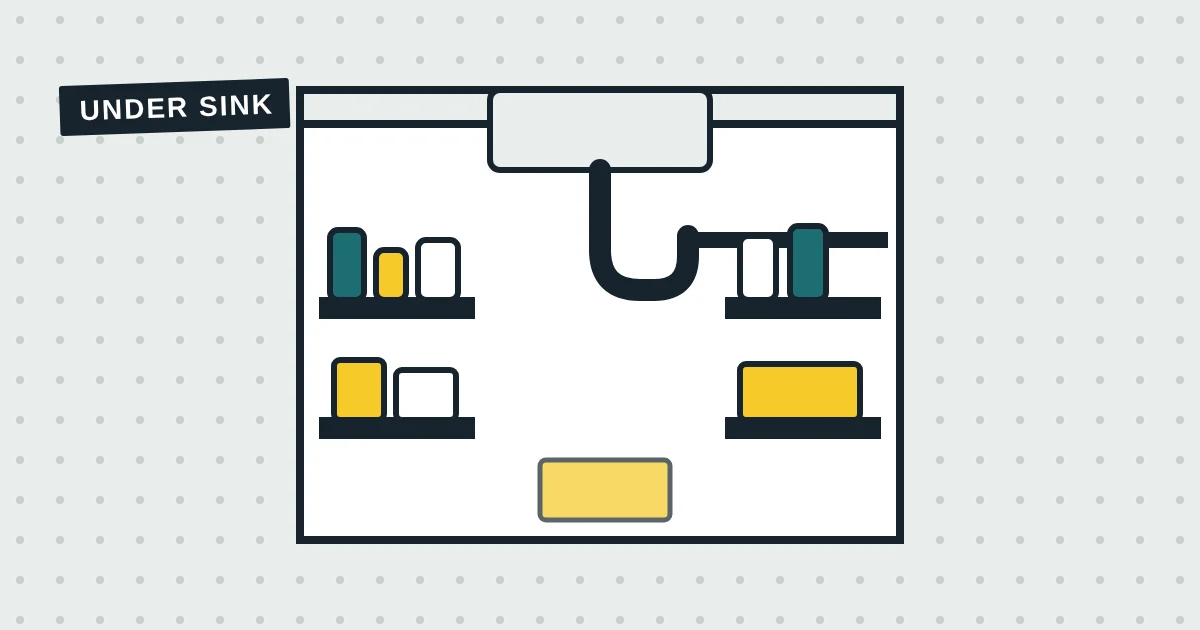
Short answer: split the cabinet into three zones: the full-height spaces left and right of the pipes, and the low space under the drain trap. Put a sliding two-tier organizer in each side zone, a drip tray or low bins under the trap, and hang spray bottles from a tension rod. Measure the door opening before you buy anything that slides out.
Step 1: measure the three zones
Most under-sink clutter happens because people buy an organizer for the cabinet and then find it hits a pipe, the disposal or the frame. Five measurements prevent that. Use a tape measure and a flashlight, and write the numbers down in inches.
- Inside width of the cabinet, wall to wall.
- Inside depth, from the back wall to the inside of the door frame. Subtract an inch if supply valves or hoses stick out from the back.
- Inside height, from the cabinet floor to the underside of the sink or countertop.
- Pipe zone width: the width taken up by the drain, the trap and the disposal if you have one, plus an inch of breathing room on each side.
- Height under the trap: from the cabinet floor to the lowest point of the U-shaped trap (or the bottom of the disposal).
One more: if your cabinet has a vertical post in the middle of the opening (a center stile), measure each door opening separately. A pull-out organizer must pass through that opening, which is often several inches narrower than the cabinet behind it.
Fit finder: what will actually fit
Under-sink fit finder
Enter your measurements in inches. Everything stays in your browser.
The example numbers are a common 36-inch sink base. Yours will differ, so replace them. When a product page lists dimensions, compare its width, depth and height with the zone, and make sure the width also passes the door opening.
11 under-sink ideas that work around the pipes
1. A two-tier sliding organizer in each side zone
This is the single biggest upgrade. A narrow frame with two pull-out baskets turns zone A or B into two drawers, so bottles at the back stop disappearing. Look for one that is at least half an inch narrower than the zone and the door opening, and check the top basket clears the sink bowl when it slides out. Freestanding models need no drilling; models that screw to the cabinet floor are steadier with heavy bottles.
2. A U-shaped organizer that straddles the pipes
If the side zones are too narrow for drawers (under about 8 inches), a U-shaped or expandable shelf that bridges over the drain gives you a second level across the whole cabinet. Adjustable versions slide wider or narrower and have movable panels so the pipes can pass through.
3. Low clear bins or a drip tray under the trap
Zone C is short, but it is perfect for flat things: extra sponges, dishwasher pods in a lidded container, a box of trash bags on its side. Clear bins let you see what is there, and anything in a tray is lifted off the cabinet floor if a fitting starts to drip.
4. A tension rod for spray bottles
A spring tension rod wedged across the top of a side zone (or across the whole cabinet, above the trap) lets you hang spray bottles by their triggers. They take no floor space and you can grab one without moving anything else. Use a rod rated for the width and check it does not press on the pipes.
5. A door-mounted rack for sponges, gloves and brushes
The inside of the door is free space, as long as whatever you mount clears the shelf edge, the sink bowl and the disposal when the door closes. Measure the gap between the closed door and the nearest obstacle before choosing a rack. Over-the-door hanging racks work on most cabinet doors without screws.
6. A waterproof cabinet mat
Sink base cabinets are often particleboard, which swells when it gets wet. A cut-to-fit mat or a flexible tray with a raised lip catches drips and makes a leak visible as a puddle instead of a soft, stained floor you discover months later.
7. Stacking drawers for small things
Small items such as dishwasher pods, spare drain stoppers and cleaning cloths get lost in a deep cabinet. A short stack of clear drawers in a side zone gives each a home, and labels on the front mean anyone in the house can put things back.
8. A home for trash bags
Keep the roll of trash bags in its box, laid on its side in zone C, or in a slim dispenser on a side wall so you can pull one bag at a time. If your trash can lives in this cabinet, keep the next bag in the bottom of the can under the current one.
9. A turntable for the deep corners
In wide or deep cabinets, a small turntable (lazy Susan) in a back corner turns hard-to-reach space into usable space. A spin brings the bottle at the back to the front. It works best for upright bottles of similar height.
10. Hooks on the side walls
The cabinet’s side walls can hold a dustpan, a scrub brush or rubber gloves on adhesive hooks. Under-sink cabinets can be damp, so choose hooks made for humid spaces, clean the surface first and follow the package weight limit. Adhesive does not hold on bare, unfinished wood.
11. A child safety latch
If children live in or visit your home, add a latch before you add anything else. The U.S. Consumer Product Safety Commission advises storing household products in cabinets with child safety latches or locks, keeping them in their original containers, and re-engaging the latch after every use. Most latches install on the inside of the door without visible marks.
What to keep under the sink, and what to move
| Keep here | Move somewhere else |
|---|---|
| Dish soap and dishwasher detergent refills (latched cabinet if kids visit) | Bulk paper towels, napkins and anything else ruined by a leak |
| Sponges, brushes, rubber gloves | Cardboard boxes that soak up water |
| Trash bags | Rarely used cleaners: group them in one bin on a high shelf |
| One all-purpose spray and one glass spray | Duplicates of the same product (finish the open bottle first) |
| A small bucket or caddy you carry from room to room | Paint, pesticides and garage chemicals |
A simple test: if you would not use it within arm’s reach of the sink at least once a month, it can live elsewhere.
Leaks and safety
- Look at the pipes once a month. Run the tap for a minute, then check the trap, the supply lines and the dishwasher hose with a flashlight. A dry paper towel under each joint shows slow drips.
- Keep the shut-off valves reachable. Do not block them with organizers. In an emergency you need to turn them off quickly.
- Keep products in their original containers. CPSC warns against moving household chemicals into food or drink containers. Never mix cleaners.
- If a child swallows something, call Poison Help at 1-800-222-1222 right away.
Mistakes to avoid
- Measuring the cabinet but not the door opening. The center stile is the number one reason pull-outs get returned.
- Buying for the cabinet you wish you had. Organizers that are too tall hit the sink bowl; too deep, and the door will not close.
- Filling every inch. Leave the pipes visible. You want to notice a drip early.
- Storing in the boxes things came in. Cardboard and moisture do not mix.
Frequently asked questions
What is the best way to organize under the kitchen sink?
Measure the space on each side of the pipes and the height under the drain trap first. Put a sliding or two-tier organizer in each side zone, low bins or a drip tray under the trap, and hang spray bottles from a tension rod. Keep only things you use at the sink and lock away cleaners if children visit.
Will a pull-out organizer fit if my cabinet has a center post?
Only if the organizer is narrower than the door opening on its side of the post. Many sink base cabinets have a center stile that makes each opening several inches narrower than the cabinet behind it. Measure the opening, not just the inside of the cabinet.
Should I put a mat under the sink?
A waterproof cabinet mat or drip tray with a raised edge is one of the most useful things you can put there. It protects the cabinet floor from slow leaks and makes a drip easy to spot before it soaks the particleboard.
Is it safe to store cleaning products under the sink?
It is common, but if young children live in or visit your home, the U.S. Consumer Product Safety Commission advises keeping household chemicals in their original containers in a cabinet with a child safety latch or lock. If you cannot latch the sink cabinet, move cleaners to a high cabinet.
How do I organize under a sink with a garbage disposal?
The disposal takes most of the middle and hangs lower than a plain trap, so zone C under it is usually too short for bins. Use the two side zones for slim organizers, mount a narrow rack on the door if it clears the disposal when it closes, and keep the space around the disposal switch and power cord clear.
What should not be stored under the kitchen sink?
Anything that is ruined by water, such as paper towels in bulk or cardboard boxes, and anything dangerous if a child gets into an unlatched cabinet. Avoid storing items so tightly that you cannot see the pipes, because then you will not notice a leak.