 By
By 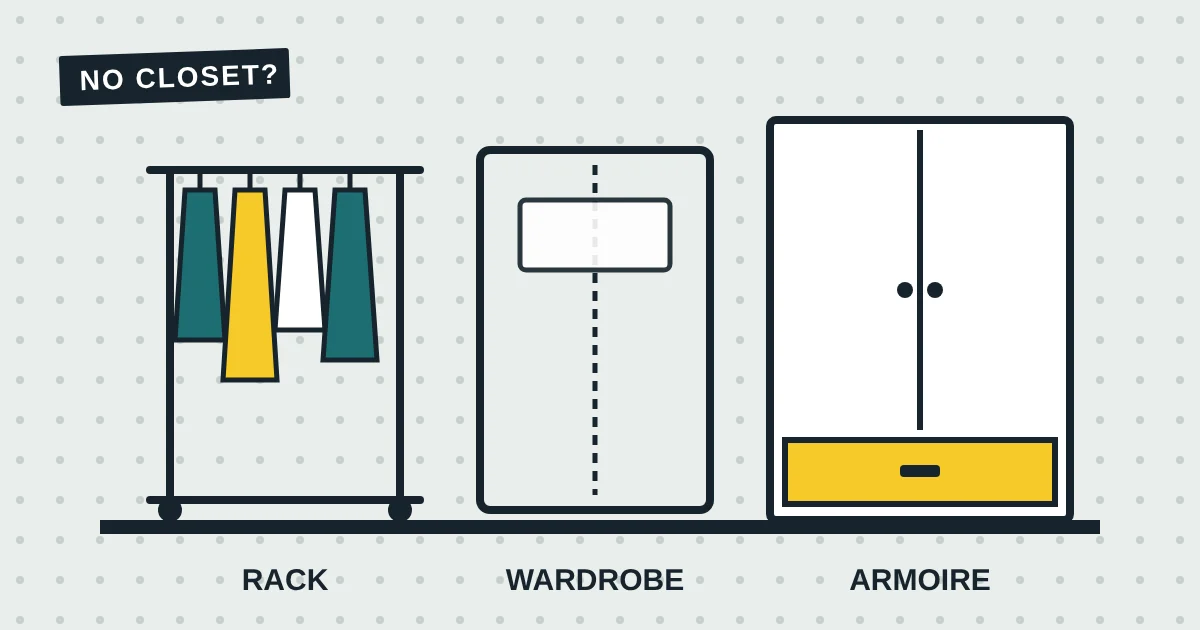
Short answer: if you rent and may move within two years, get a heavy-duty open clothing rack and keep it under its weight rating. If the clothes would be on view in a shared room or a studio and you are staying put, get an armoire with at least 20 inches of inside depth, and anchor it. A fabric wardrobe is the budget way to hide clothes, but in owner complaints it is the first of the three to fail.
A note from Eugene: I rent out properties and have done seven renovations, so I think about furniture the way a landlord does: does it fit the room that is actually there, and does it come out cleanly on moving day? I haven’t owned these exact models. The comparisons come from their listed specifications, the CPSC’s tip-over guidance and about 70 recent critical owner reviews.
The three options at a glance
| Open clothing rack | Fabric wardrobe | Wooden armoire | |
|---|---|---|---|
| Typical footprint | 18–22″ deep; rod 42–75″ wide | 18–20″ deep; 36–67″ wide | 20–22″ deep; about 36–40″ wide |
| Hanging space for the floor it uses | Most | Good | Least (walls and doors take room) |
| Hides clothes, keeps dust off | No | Yes | Yes |
| Assembly (owner reports) | Minutes to half an hour | An hour or more; covers are fiddly | Several hours, often two people |
| Moving day | Easy: rolls or comes apart | Easy, but zippers and connectors suffer | Hard: particle board weakens when moved |
| Main failure in owner complaints | Rods bend when fully extended; wobbles when moved full | Zippers come off the track; connectors crack; rods sag | Damaged or misdrilled panels; doors that don’t line up |
| Tip-over | Low and wide; low risk | Light; low risk | Tall and heavy: anchor it |
| Cats | No fabric to shred | Fabric is a scratching target | Doors close; fine |
Measure first: the three numbers that decide it
- Wall width you can give up. Leave the door swing and the path to the bed clear. Hanging space is the rod length, so subtract a few inches for the frame.
- Depth. A typical adult hanger is about 17 inches wide. Clothes need about 20–24 inches of depth to hang without crushing, and an armoire’s inside depth is an inch or two less than the listed outside depth. Check the room’s depth too: a 22-inch-deep unit plus its doors needs about 4 feet of clear floor in front.
- How much rod you need. Count what you hang. Our closet rod calculator turns a clothing count into inches of rod, and tells you when double-hanging is the answer.
Which one fits your room?
No-closet picker
Answer four questions. The suggestion is a starting point, not a rule.
Option 1: an open clothing rack
Best for: renters, people who move often, and anyone who needs the most hanging space for the floor and money spent.
- Why it works: a rack is nothing but rod, so almost all of its footprint holds clothes. Good ones roll, so you can pull it out to vacuum and take it with you.
- What goes wrong: in owner complaints, extendable rods bend when pulled out to full width, racks wobble or tip when moved fully loaded, “collapsible” sometimes means taking it apart, and some arrive with bent or missing parts.
- How to avoid it: buy a rating far above your load, keep the rod short of full extension, put heavy coats near the uprights, and empty the rack before you roll it across a rug.
- The downside nobody fixes: your clothes are on display. A tidy rack in matching hangers looks intentional; an overstuffed one makes a small room feel smaller.
Option 2: a fabric wardrobe
Best for: a budget fix that hides clothes and adds shelves, in a room you will not stay in for long.
- Why it works: a light metal frame and a zip-up cover give you a closet’s worth of hanging space and shelves without tools, and the cover keeps dust off.
- What goes wrong: this was the most complained-about category in my sample. Zippers come off the track (sometimes during assembly), plastic connectors crack, fabric shelves tear, rods sag, and the instructions are often poor. One owner’s cats destroyed the fabric shelves.
- How to avoid it: keep the load light (one small model lists 35 pounds), hang heavy coats on a separate hook, fit the cover as the instructions say before you finish the frame, and never pull the zipper around a tight corner.
- Cats: we have a big black cat, Tim, and I would not put a fabric wardrobe in a room he could get into. The panels look like a scratching post to a cat.
Option 3: a wooden armoire
Best for: studios and shared rooms where clothes would otherwise be on view, and anyone who will stay put for a few years.
- Why it works: it is real furniture. Doors close, the room looks finished, and it usually adds a drawer or shelves.
- What goes wrong: in owner complaints, armoires arrive with damaged or misdrilled panels, take two people four or five hours to assemble, and end up with doors that hang unevenly. Several owners found the inside too shallow or the rod too short for adult hangers, and engineered-wood pieces weakened when they were moved.
- How to avoid it: check the inside depth (20 inches or more), assemble it in the room where it will stay, check every panel before you start so damaged parts can be replaced, and plan for help.
- Anchor it. The U.S. Consumer Product Safety Commission counted 234 deaths from clothing storage furniture tipping over between January 2000 and April 2022, 199 of them children, and recommends anchoring furniture to the wall. Its tip-over standard covers dressers, armoires and wardrobes made after September 1, 2023, but anchoring is still the advice. In a rental, ask your landlord: an anchor leaves two small screw holes that are easy to patch on move-out.
The verdict
My overall pick for most small rentals is the open rack, because it is the hardest to get wrong. If seeing your clothes bothers you, a tension rod and a curtain in front of a rack placed in an alcove hides it without drilling. Our no-drill storage guide shows how.
Picks for a room with no closet
Affiliate note: some links in this guide go to Amazon. As an Amazon Associate we earn from qualifying purchases, at no extra cost to you. We choose products for fit and specifications, not for the commission.
Rod extends 42–67″, 18″ deep, 4-inch casters.
Check on AmazonRod extends 51–75″, plus shelves for shoes and bins.
Check on AmazonFabric-covered frame, 36″ wide, 19.5″ deep.
Check on Amazon36.3″ wide, 21.4″ deep, 5-year parts warranty.
Check on AmazonShopping on Black Friday? Add our top pick, the Simple Houseware Heavy Duty Clothing Garment Rack, to your Amazon cart now so it is ready when deals start.
How I chose
- I compared listed dimensions, weight ratings and warranties against the three numbers above.
- I read about 70 recent critical reviews (one to three stars) of seven popular racks, fabric wardrobes and armoires, and grouped the problems.
- I checked each listing on October 17, 2026 for stock and U.S. delivery.
- I haven’t owned these products. Picks are based on specifications, warranties and owner feedback.
Best for most renters: Simple Houseware Heavy Duty Clothing Garment Rack
A steel rack with a rod that extends from 42 to 67 inches, a footprint just 18 inches deep and 4-inch swivel casters. It is one of the longest-running best sellers in garment racks.
- Shallow 18-inch footprint suits small bedrooms.
- Quick to assemble, easy to move out.
- Width adjusts to the wall you have.
- The extended rod bends when pulled out to full length and loaded.
- Wobbles or tips if you roll it fully loaded, especially on carpet.
- “Collapsible” means taking it apart, not folding it.
Warranty and returns: covered by Amazon’s standard return window; no separate maker warranty is listed.
Skip it if you have a lot of heavy coats: at 62 inches tall and 150 pounds it suits everyday clothes; long dresses may touch the base.
Check it on AmazonMost storage: HOKEEPER 525 lb Clothing Rack with Shelves
A heavier rack with an E-shaped frame, a rod that extends from 51 to 75 inches, three shelves for shoes or bins and four locking wheels. The maker lists 525 pounds in total, 310 of it on the rods.
- Taller and wider: closer to a real closet.
- Shelves below hold shoes and a laundry basket.
- Locking wheels stop it creeping.
- Some arrived with bent or warped tubes that were hard to fit.
- Instructions come as a QR code; a few owners could not use it.
- One owner reported heavily oiled wheels with a strong smell; the extension arms felt flimsy to others.
Warranty and returns: the maker advertises free replacement parts; check them on arrival, within Amazon’s return window.
Skip it if your room is shallow: at 22 inches deep it needs more floor than the Simple Houseware rack.
Check it on AmazonBudget, hidden: Whitmor 36-Inch Clothes Closet
A metal frame with a white polypropylene cover, a zippered front opening and a clear window. At 36 inches wide and 19.5 inches deep it fits beside a bed or in a corner.
- Hides clothes and keeps dust off.
- Small footprint.
- Light enough to move with one hand.
- Zippers come off the track, sometimes during assembly, and have no stops.
- Plastic connectors and thin metal sag or break under weight.
- Hard to fit the cover on the frame.
Warranty and returns: the listing says the maker’s warranty can be requested from customer service; inspect the zipper before you assemble.
Skip it if you have heavy coats, a cat, or plans to use it for years.
Check it on AmazonLooks like furniture: Sauder Palladia Armoire
A two-door armoire with a garment rod behind the doors and a drawer below, from a long-established American furniture brand. The listing states a 5-year parts warranty.
- Hides everything; looks like a finished room.
- Doors protect clothes from dust, light and pets.
- Longest listed warranty of the four.
- Damaged or scratched panels on arrival, and some holes that did not line up.
- Four hours or more to assemble; doors may hang a little unevenly.
- One owner found the rod about half an inch short.
Warranty and returns: 5-year parts warranty listed by the maker; check every panel before assembly so damaged parts can be replaced.
Skip it if you move often, or your room cannot spare about 4 feet of clear floor in front of it.
Check it on AmazonAlso worth adding
- An anti-tip kit for the armoire: furniture anchors, 10-pack with stainless steel brackets and mounting hardware. Screw into a wall stud, or use anchors rated for your wall, and follow the instructions.
Frequently asked questions
What can I use instead of a closet?
An open clothing rack, a fabric wardrobe (a metal frame with a zip-up cover) or a wooden armoire. A rack gives the most hanging space for the money, a fabric wardrobe hides clothes on a budget, and an armoire looks like furniture and lasts longest. Add a dresser or under-bed bins for folded clothes.
How deep does a wardrobe need to be for hangers?
A typical adult hanger is about 17 inches wide, so clothes hang across roughly 20 to 24 inches of depth. Measure the inside depth of any wardrobe or armoire, not the outside: under about 20 inches inside, hangers hit the doors or the back.
Are fabric wardrobes worth it?
As a budget or short-term fix, yes. In owner complaints they are the weakest of the three: zippers come off the track, plastic connectors crack and rods bend under weight. Keep heavy coats elsewhere and keep cats away from the fabric.
Do I need to anchor an armoire to the wall?
Yes. The U.S. Consumer Product Safety Commission recommends anchoring dressers, armoires and other clothing storage furniture to the wall to prevent tip-overs. In a rental, ask your landlord first; anchors leave small holes that are easy to patch.
How much weight can a clothing rack hold?
Check the listed capacity and how it is measured. Listed ratings range from about 35 pounds for small fabric closets to hundreds of pounds for heavy-duty racks, but owners report that extendable rods bend when pulled out to full width, so stay well under the rating with the rod fully extended.
The Small Space Fix is a participant in the Amazon Services LLC Associates Program. As an Amazon Associate we earn from qualifying purchases. Product details can change; check the current listing before you buy.