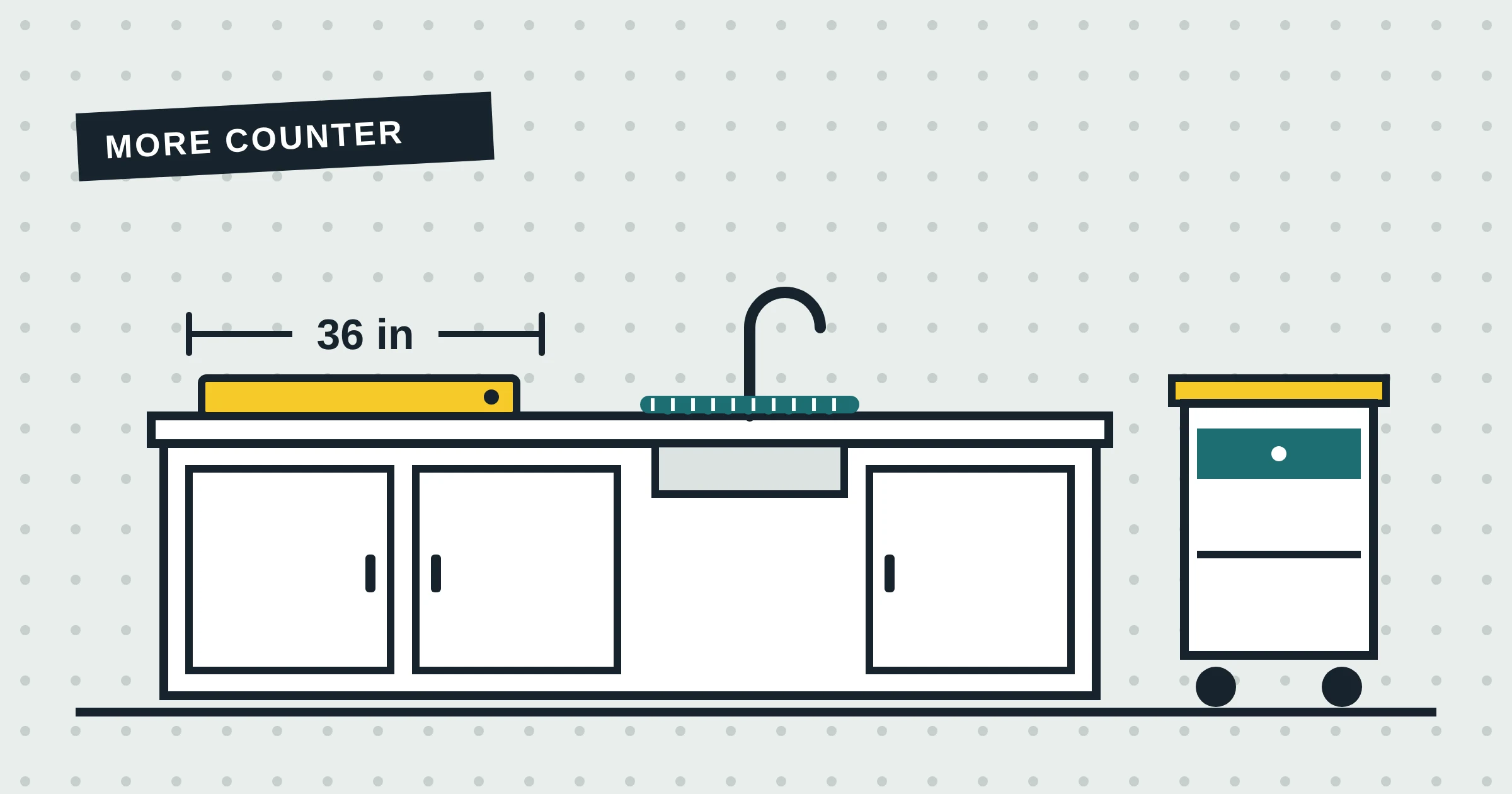
Short answer: the fastest way to get counter space in a small kitchen is to take things off it. Move the dish rack over the sink, put appliances you use less than daily in a cabinet or on a rolling cart, hang tools on the wall or a cabinet door, and prep on an over-the-sink cutting board. Aim for one clear stretch of about 36 inches next to the sink, the minimum prep area kitchen designers plan for.
How much counter space do you actually need?
The National Kitchen & Bath Association’s planning guidelines, which kitchen designers use for new kitchens, give useful targets even for a tiny rental:
| Where | NKBA guideline | What it means in a small kitchen |
|---|---|---|
| Prep area | At least 36″ wide × 24″ deep of continuous counter, next to a sink | Your one clear stretch for chopping. Keep it empty. |
| Beside the sink | 24″ on one side, 18″ on the other | Room to set down dirty and clean dishes. A roll-up rack over the sink can stand in for one side. |
| Beside the cooktop | 12″ on one side, 15″ on the other | Somewhere to put a hot pan down. Do not fill it with jars and oils. |
| Microwave | 15″ landing area above, below or beside it | A cart shelf next to it counts. |
Most small kitchens cannot meet all of these, and that is fine. The one worth fighting for is the 36-inch prep stretch.
How much space could you free up?
Counter space calculator
Add up every stretch of counter you can work on (not the sink or the stove), then tick what you could move. The widths are typical; measure yours for a better answer.
| Move off? | What sits on your counter | Inches it takes |
|---|---|---|
| Dish rack | ||
| Microwave | ||
| Coffee maker | ||
| Toaster | ||
| Air fryer | ||
| Knife block | ||
| Utensil crock | ||
| Paper towel holder | ||
| Fruit bowl | ||
| Mail, keys and chargers |
12 ways to get more counter space
1. Keep only daily-use items on the counter
If you do not use it every day, it lives somewhere else. Most kitchens can drop to a coffee maker and maybe a knife block. The calculator above shows what that is worth in inches.
2. Put the dish rack over the sink
A dish rack is often the single biggest thing on a small counter, about a foot and a half. A roll-up rack spans the sink, drains straight into it and rolls up into a drawer when you are done.
3. Prep over the sink
An expandable over-the-sink cutting board turns the sink into prep space and lets scraps go straight into the basin. Check that it is wider than your sink opening and that the sink is empty first.
4. Add a rolling cart as a second counter
A small kitchen cart on wheels gives you a work surface where you need it and parks in a corner or by the fridge when you do not. Look for a drawer and a lower shelf for the appliances you moved off the counter.
5. Store small appliances in a cabinet or on the cart
Toasters, air fryers and blenders do not need to live out. Put them on the bottom shelf of the cart or in the cabinet closest to an outlet, and take them out when you use them.
6. Move the microwave off the counter
A microwave can take 20 inches or more. Put it on a cart shelf or a sturdy microwave stand, and keep the 15 inches of landing space next to it in mind.
7. Use the wall
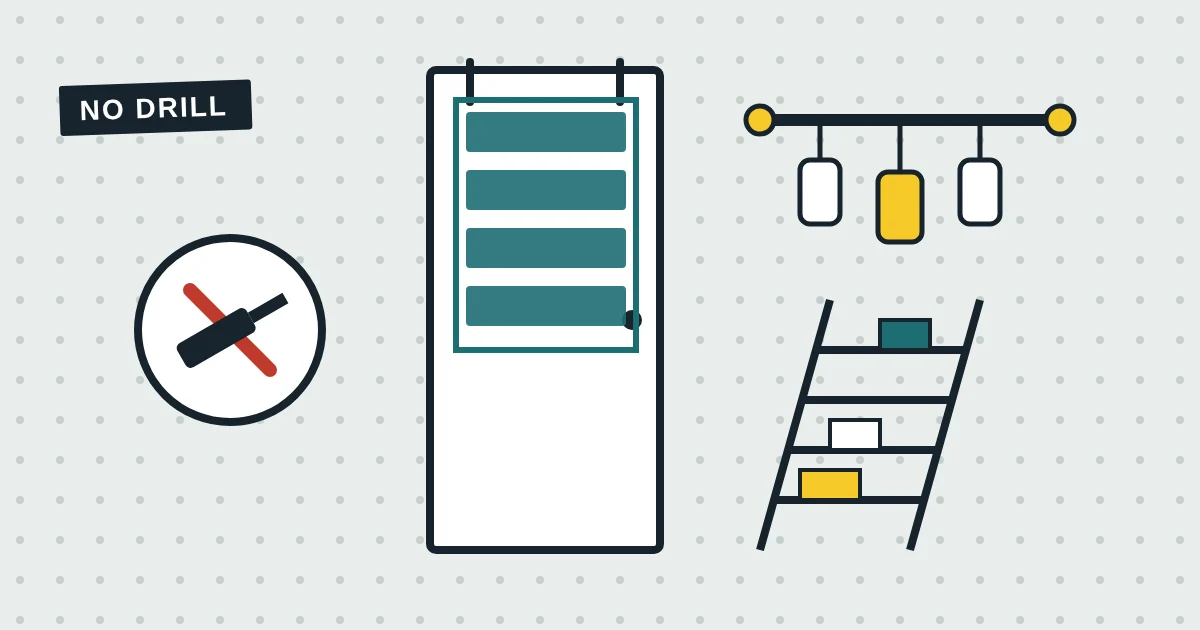
A rail with S-hooks holds utensils, mugs and a small basket; a magnetic strip holds knives so the block can go. Both usually need screws. Renting? Ask your landlord, or see our no-drill storage ideas for adhesive and tension options, and respect the weight limits.
8. Use the inside of cabinet doors
Adhesive hooks or a slim over-the-door rack inside a cabinet door holds measuring cups, pot lids, foil and wrap, so they stop crowding the counter and drawers.
9. Get the paper towels and utensil crock off the counter
Each takes only a few inches, but together with a fruit bowl and a stack of mail they can eat a whole prep zone. Hang paper towels under a cabinet or on a wall rail; move utensils into a drawer.
10. Keep the stovetop clear
It is tempting to use the stove as overflow space. Do not store things on it: the NFPA warns to keep anything that can catch fire, including oven mitts, wooden utensils, food packaging, towels and curtains, away from the stovetop. Stove covers and “noodle boards” are only for when every burner is off and cool.
11. Give the mail and chargers a home outside the kitchen
A wall pocket or a tray by the front door stops the counter from becoming the drop zone.
12. Cook in stages and clean as you go
Prep everything into small bowls and stack them, wash tools as you finish with them, and move finished dishes to the table or the cart. In a small kitchen, the cleanup routine is part of the storage plan. More ideas for the pantry and under the sink are in our guides to small pantry organization and under-sink organization.
Small-kitchen helpers we would buy
Affiliate note: some links in this guide go to Amazon. As an Amazon Associate we earn from qualifying purchases, at no extra cost to you. We choose products for fit and specifications, not for the commission.
Spans sink openings up to 16.5″, rolls up for storage.
Check on AmazonBamboo board that expands to 33.5″ wide.
Check on AmazonWood top, drawer and shelf on a 22″ × 18″ footprint.
Check on AmazonShopping on Black Friday? Add our top pick, the Surpahs Roll-Up Dish Drying Rack, to your Amazon cart now so it is ready when deals start.
How we chose
- Each pick frees counter space in a way this guide recommends: dishes over the sink, prep over the sink, and a second surface on wheels.
- We checked listed dimensions against typical small-kitchen sinks and floor space, and favored long-running, widely bought products with a large volume of owner feedback.
- We checked each listing on October 17, 2026 for U.S. availability.
- We have not tested these products ourselves. Our picks are based on specifications and owner feedback.
Biggest gain: Surpahs Roll-Up Dish Drying Rack
A roll-up rack of silicone-coated steel rods that lies across the sink, drains straight into it and rolls up into a drawer when you are done.
- Takes the dish rack, often the biggest thing on the counter, off the counter entirely.
- Doubles as a trivet and a spot to rinse produce.
- Downside: It holds fewer dishes than a full rack and you cannot use that half of the sink while it is down; measure your sink opening first.
Skip it if your sink is wider than 16.5 inches: look for a longer roll-up rack.
Check it on AmazonPrep space: Kindled Ivys Expandable Over-the-Sink Cutting Board
A bamboo cutting board with sliding extensions that rest on the sink edges, with a juice groove around the edge.
- Adds a full prep zone without adding furniture.
- Works as a serving tray or normal board too.
- Downside: Bamboo needs hand washing and occasional oiling, and you cannot use the sink while it is in place.
Skip it if you already have a clear 36-inch prep stretch.
Check it on AmazonSecond counter: Yaheetech Rolling Kitchen Cart
A small cart with a wood top, a drawer, storage space and side hooks for towels or utensils. Roll it next to the stove when you cook and back into a corner when you are done.
- A second work surface and a home for the appliances you took off the counter.
- Small footprint for a galley kitchen.
- Downside: A cart is only useful if there is somewhere to park it; measure the corner first, and check the assembly notes on the listing.
Skip it if your kitchen has no free floor space at all.
Check it on AmazonCooking a big meal in a tiny kitchen
- Borrow a folding table for the day and set it up as a second prep station or a serving buffet.
- Prep the day before: chop vegetables, make dressings and desserts, and store them stacked in the fridge.
- Use the oven in shifts and let side dishes wait on the cart under foil.
- Clear the dish rack before you start and run the dishwasher or wash up between courses.
- Keep the area around the stove clear of towels, packaging and paper, as the NFPA advises.
Counter-clearing checklist
Get your prep space back
Your ticks are saved in this browser only.
Frequently asked questions
How do I get more counter space in a small kitchen?
Take things off it first: keep only daily-use items out, move the dish rack over the sink, put small appliances in a cabinet or on a rolling cart, and hang utensils on a wall rail or inside cabinet doors. Then add prep space with an over-the-sink cutting board or a kitchen cart.
How much counter space do I need to cook?
The National Kitchen & Bath Association recommends a continuous prep area at least 36 inches wide and 24 inches deep next to a sink, plus landing space beside the sink, cooktop, refrigerator and microwave. In a small kitchen, aim first for that one 36-inch stretch.
What can I do with a kitchen that has no counter space?
Use the sink and wheels: an over-the-sink cutting board and a roll-up dish rack turn the sink into work space, and a small rolling cart adds a second surface you can park out of the way. Store appliances on the cart and use the walls and cabinet doors for tools.
Is it safe to put a cover over the stove for more counter space?
Only when every burner is off and cool. Do not store things on the stovetop: the NFPA advises keeping anything that can catch fire, such as oven mitts, wooden utensils, food packaging and towels, away from it.
Where should I put the microwave in a small kitchen?
Off the counter if you can: on a sturdy cart shelf or a microwave stand. The NKBA suggests at least 15 inches of landing space above, below or beside a microwave, so leave a clear spot next to it.
How do I store small appliances without counter space?
Keep the one you use daily out and move the rest to the cabinet nearest an outlet, the bottom shelf of a kitchen cart, or a high shelf if you use it rarely.
The Small Space Fix is a participant in the Amazon Services LLC Associates Program. As an Amazon Associate we earn from qualifying purchases. Product details can change; check the current listing before you buy.