 By
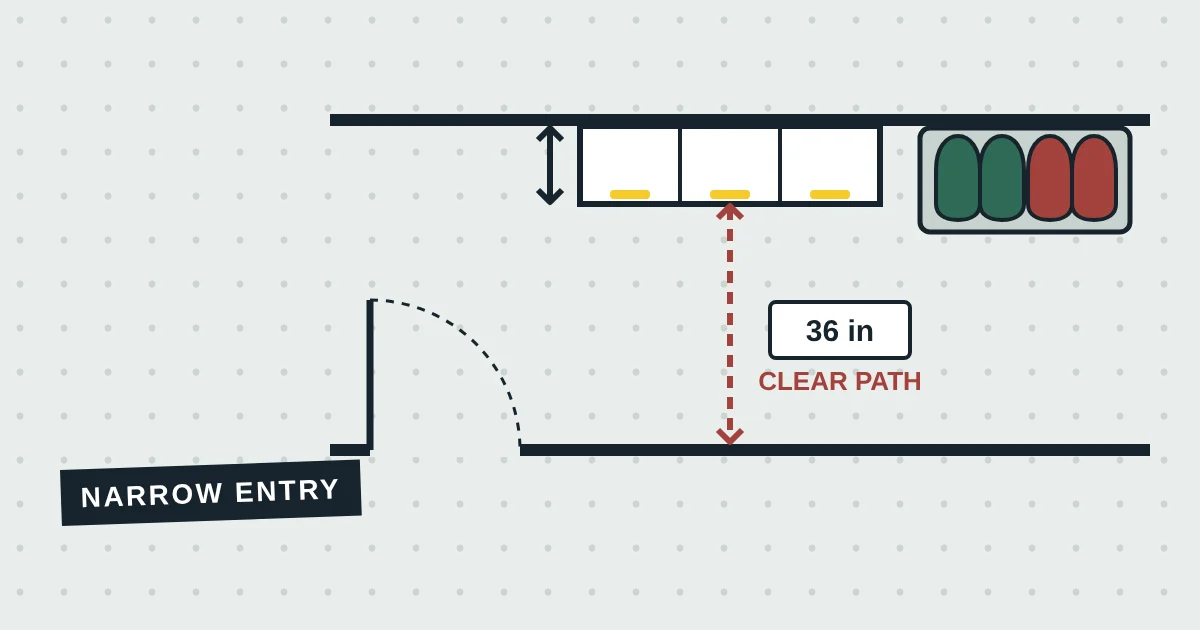
Short answer: measure your hallway at its narrowest point and subtract 36 inches, the minimum hallway width in the International Residential Code. What is left is the deepest shoe storage you can put there without making the hall narrower than a code-built hallway. Under about 9 inches left, keep the floor clear and use a door organizer. With 9.5 inches, a slim flip-drawer cabinet fits and holds about 18–24 pairs on 31.5 inches of wall. With 10 inches, a 10-tier shoe tower holds 20–25 pairs on just 17 inches of wall. With 11.5 inches or more, a shoe bench gives you a seat for boots. Keep only the shoes you wear this week by the door, put a boot tray under the wet ones, and anchor anything tall.
A note from Eugene: I rent out apartments, and the entry is the first thing that looks messy at a viewing, because the shoe pile has nowhere to go. I haven’t owned all of these organizers. The sizes come from the makers’ listings, the hallway width from the International Residential Code as explained by Fine Homebuilding, the tip-over advice from the U.S. Consumer Product Safety Commission (CPSC), and the warnings from Amazon’s review summaries for each product, which I read on October 22, 2026.
Measure four things
- Hallway width at the narrowest point. Measure baseboard to baseboard, not at waist height, and do it where the storage will stand. A radiator, a door frame or a light switch box can steal an inch or two.
- The door swing. Open the front door fully and mark the arc on the floor with tape. Nothing can stand inside it. Do the same for any closet or bathroom door that opens into the hall.
- Free wall length. Measure the stretch of wall with no door, radiator, outlet you need, intercom or thermostat. This decides whether a 17-inch tower or a 31.5-inch cabinet fits.
- Height limits. Note anything on the wall: hooks, a mirror, a light switch, a panel. A 68-inch tower will cover a switch at the usual height, and a cabinet top at 47 inches can become a handy shelf for keys only if nothing hangs above it.
The 36-inch rule
The International Residential Code, the model code most U.S. states adopt for houses and townhouses, says a hallway must be at least 3 feet wide. Apartment buildings fall under other codes, and the rule applies to walls, not to your furniture, but it is the best target you have for the clear path: if your shoe rack leaves less than 36 inches, the hallway is narrower than a new hallway is allowed to be. Block Renovation’s guide calls 42 inches a more comfortable width for daily use, and that is worth aiming for if two people leave at the same time or you carry a stroller or groceries.
| Hallway width | Depth left with a 36″ path | What fits |
|---|---|---|
| 36″ or less | None | Keep the floor clear. Use an over-door organizer on another door and wall hooks for bags. |
| 40–44″ | 4–8″ | Still no freestanding piece from our list. A door organizer, hooks and a small tray just inside the door. |
| 46″ | 10″ | A slim flip-drawer cabinet (9.45″) or a 10-tier tower (10″) |
| 48″ | 12″ | Also a small shoe bench (11.3″) |
| 52″ | 16″ | A bench plus a full-size 15.5″ boot tray |
| 60″ or more | 24″ | Most standard shoe cabinets and storage benches |
Many apartment entries are not hallways at all, but a corner inside the front door. The same rule works: keep 36 inches between the storage and whatever is opposite, and keep the door swing clear.
Shoe storage fit calculator
What fits your entry, and does it hold enough?
Enter your measurements in inches. Everything runs in your browser.
Sizes and pair counts are the makers’ listed figures for the products in this guide. Large men’s sneakers and high-tops take more room than listings assume, so expect the lower end.
How many pairs belong at the door
A small entry cannot hold every shoe you own, and it does not need to. Split your shoes into three groups:
- At the door: what each person wore in the last week, usually two or three pairs each, plus one free spot for a guest.
- In the bedroom closet: dress shoes, sandals in winter, boots in summer. Our small closet guide shows where a shoe rack fits under a double-hung rod.
- Under the bed: off-season and rarely worn pairs, in a flat zip-up organizer. Popular under-bed shoe organizers hold about 12 pairs of sneakers per pair of bags. See our under-bed storage guide for what fits under your bed.
For two adults with three pairs each, that is six pairs at the door: one tower or a three-drawer cabinet holds them with room to spare. A family of four with three pairs each needs 12, still one unit, but the calculator will tell you when a bench alone is not enough.
How much shelf does a pair take? The makers’ own figures work out to about 8 to 9 inches of shelf per adult pair: a 17-inch shelf holds two pairs, and a typical clear door pocket is 4.3 inches wide, for one shoe. Big sneakers and boots need 10 inches or more, and tall boots need a shelf removed above them.
Five types compared
| Type | Depth | Pairs (listed) | Best for | Trade-off |
|---|---|---|---|---|
| Over-the-door rack | About 7.5″ out from the door | Up to 36 on a metal rack; 24 pockets on a fabric organizer | Hallways too narrow for anything on the floor | Not for most front doors; the door must still close; pockets are small for big shoes |
| Slim flip-drawer cabinet | About 9.5″ | 18–24 (3 drawers), 24–36 (6 drawers) | A narrow hallway that should look tidy | Needs anchoring; very large shoes may not fit the drawer |
| Narrow 10-tier tower | About 10″ | 20–25 | The most pairs on the least wall: 17″ wide | Open shelves look busier; tall and light, so it needs a wall strap |
| Shoe bench | About 11.3″ | About 4 | A place to sit and pull boots on | Holds few pairs; pair it with a tower or a door rack |
| Boot tray | 12.8–15.5″ | 1–4 | Wet and salty boots in winter | Deep for a narrow hall; slim trays hold fewer pairs |
The flip-drawer cabinet is the one most people don’t know about. The shoes stand at an angle in drawers that tip forward from the top, so the whole cabinet is under 10 inches deep, about half the depth of a regular shoe cabinet. Each drawer swings out as you open it, so you briefly stand in the path, which is fine in a home but worth knowing.
Wet boots and winter
- Give wet boots a tray, not a shelf. A tray with a raised edge holds melted snow and road salt so it does not sit on the floor or drip onto the shoes below.
- Choose the tray by depth. A full-size tray like the Stalwart is 23.75 by 15.5 inches and holds about four pairs, according to owners. In a narrow hall, two 16.7 by 12.8-inch trays end to end take 3 inches less depth.
- Dry first, then store. Let boots dry on the tray before they go into a closed cabinet, so damp shoes are not shut in a drawer.
- Boots go at the bottom. On a tower, keep heavy boots on the lowest tiers and remove one tier to make room for tall boots; the maker of the tower in this guide says a tier can be taken out for boots.
- Keep the tray off the path. A tray with a lip is something to trip on. Put it against the wall, under a bench if it fits, or just inside the door.
Anchor tall pieces
The CPSC’s Anchor It campaign asks families to anchor furniture such as bookcases and dressers to the wall, and to store heavier items on lower shelves. A shoe cabinet with drawers that tip out, or a 68-inch tower with a 10-inch footprint, belongs in that group: both get top-heavy when the upper levels are full, and both stand where people walk.
- Use the anti-tip strap or kit if one is in the box; the BORNOON cabinet lists an anti-tip feature. For a tower without one, a furniture anti-tip strap from a hardware store does the job.
- Load from the bottom up: boots and heavy sneakers low, flats and slippers high.
- Renting? An anti-tip strap usually needs one or two small screws, and the holes are easy to fill when you move out. Check your lease, and see our no-drill guide for what else you can do without tools.
Entryway setup checklist
What owners complain about
Amazon sums up each product’s reviews by topic and shows how many customers mention each topic positively or negatively. I read these counts on October 22, 2026, for the picks below and for one very popular tower we decided not to recommend.
| Product | Most-mentioned problem | Customers mentioning it (positive / negative) |
|---|---|---|
| FIDUCIAL HOME 10-tier rack (not picked) | Durability | 100 / 458 |
| FIDUCIAL HOME 10-tier rack (not picked) | Stability: wobbly | 102 / 296 |
| Simple Houseware door organizer | Pocket size: too small for some shoes | 1,115 / 503 |
| SONGMICS shoe bench | Size: smaller than expected | 495 / 294 |
| Whitmor over-the-door rack | Fit on the door | 109 / 132 |
| 10-tier narrow tower (our pick) | Sturdiness: mostly good, some wobble | 401 / 140 |
| BORNOON flip-drawer cabinet | Storage capacity: big shoes | 247 / 51 |
| WATANIYA slim boot trays | Stability: slides on tile | 16 / 29 |
Two lessons. First, fit is the top complaint for almost every type: pockets too small for men’s sneakers, benches smaller than the photos, door racks that don’t sit right on a particular door. Measure your biggest pair and your door, not just the hallway. Second, the cheapest tall racks are wobbly. The FIDUCIAL HOME tower has more than 27,000 ratings, but more owners complain about its durability and stability than praise them, which is why our tower pick is a sturdier one with a better ratio.
Shoe storage that fits narrow entries
Affiliate note: some links in this guide go to Amazon. As an Amazon Associate we earn from qualifying purchases, at no extra cost to you. We choose products for fit and specifications, not for the commission.
9.45″ deep, 18–24 pairs, anti-tip kit.
Check on Amazon10″ × 17″, 20–25 pairs.
Check on AmazonShopping on Black Friday? Add our top pick, the BORNOON slim shoe cabinet, to your Amazon cart now so it is ready when deals start.
How I chose
- I sorted options by depth first, because depth decides what fits a narrow hallway.
- I compared listed sizes and pair counts against the 36-inch path and typical wall lengths.
- I read Amazon’s review topic counts and dropped a best-seller whose negative mentions outnumbered the positive ones.
- I checked each listing on October 22, 2026 for stock and U.S. delivery.
- I haven’t owned all of these. Picks are based on specifications and owner feedback, and I say what owners complain about.
Best for a narrow hallway: BORNOON Slim Shoe Cabinet with 3 Flip Drawers
A closed cabinet only 9.45 inches deep, with three tip-out drawers, each holding a two-tier shoe rack with adjustable dividers. It fits a 46-inch hallway with a 36-inch path, and the top is a shelf for keys and mail. If you have about 48 inches of wall, the 6-drawer version is the same depth and holds 24–36 pairs.
- Closed drawers hide the shoe pile, so a small entry looks tidy.
- About 3,200 ratings at 4.6 stars; quality is praised 721 times, criticized 55.
- Removable dividers take sneakers, flats, heels or ankle boots.
- Storage capacity: 51 negative mentions, usually large shoes that don’t fit the drawer.
- Sturdiness: 29 negative mentions; anchor it as the maker intends.
- Value for money: 42 negative mentions.
Warranty and returns: check the listing. Fit your biggest pair into a drawer on day one, while you can still return it.
Skip it if most of your shoes are tall boots or men’s size 12+ sneakers; an open tower handles big shoes better.
Check it on AmazonMost pairs per inch of wall: 10-Tier Narrow Shoe Tower with Hooks
A tall, open rack of fabric shelves on metal tubes, only 17 inches wide and 10 inches deep, with five hooks for keys and bags. It holds 20–25 pairs on 17 inches of wall, and you can remove a tier for tall boots.
- The best pairs-per-inch of anything here.
- No tools needed to assemble; shelves are waterproof fabric.
- Sturdiness praised 401 times, criticized 140: a much better ratio than the best-selling rival.
- Some wobble when fully loaded; strap it to the wall and keep heavy shoes low.
- Assembly: 130 negative mentions, mostly stiff connectors.
Warranty and returns: the listing states an 18-month warranty. Keep the order details.
Skip it if you want shoes out of sight, or the hall has a light switch at the height of the top tiers.
Check it on AmazonA seat for boots: SONGMICS 3-Tier Bamboo Shoe Bench
A small bamboo bench with two shoe shelves under the seat. It holds about four pairs, so it is not your main storage, but sitting down to pull on boots is the thing people miss most in a tiny entry. With more than 25,000 ratings, it is one of the most reviewed benches on Amazon.
- Fits a 48-inch hallway with a 36-inch path.
- Assembly praised almost 2,000 times.
- The maker describes the bamboo as moisture-resistant.
- Size: 294 negative mentions; at 19.7 inches wide it is a seat for one.
- Sturdiness: 318 negative mentions against 1,548 positive.
- Capacity: four pairs of adult shoes at most.
Warranty and returns: check the listing.
Skip it if your hallway is under 48 inches, or you need it to hold most of your shoes.
Check it on AmazonNothing on the floor: Whitmor 36-Pair Over-the-Door Shoe Rack
A metal and mesh rack with 12 tiers that hangs over a door or mounts on a wall. It is the answer for halls under 46 inches: hang it on a closet, bedroom or bathroom door near the entry. For flats, sandals and kids’ shoes, the Simple Houseware 24-pocket clear organizer is cheaper and thinner, with more than 130,000 ratings, but its 4.3-inch pockets are small for sneakers.
- Holds sneakers and short boots, which fabric pockets don’t.
- Mesh back helps protect the door from scuffs.
- Uses no floor at all.
- Fit on the door: 132 negative mentions; check your door’s thickness and the gap at the top.
- Stability: some shoes fall off when the door swings.
- Assembly: 156 negative mentions.
Warranty and returns: check the listing. Hang it before you load it to make sure the door still closes.
Skip it if the only door is your front door: an exterior door with a tight frame or weatherstrip may not close over the hooks.
Check it on AmazonWet boots: Stalwart All-Weather Boot Tray
A recycled-plastic tray with a raised edge that holds snowmelt, mud and salt. Owners say it fits about four pairs. For a narrow hallway, the WATANIYA PET 2-pack of slim trays (16.7 by 12.8 inches each) takes less depth, but each tray holds about one pair.
- Rated 4.7 stars from more than 4,200 owners.
- Containment praised 38 times, criticized once.
- Light enough to carry to the sink to rinse.
- Size: 12 negative mentions; too big for some entries, too small for some families.
- Value for money: 11 negative mentions.
Warranty and returns: 30 days listed.
Skip it if your hallway is under 52 inches wide; choose the slim trays instead.
Check it on AmazonCoats piling up by the door too? See where to put winter coats with no coat closet, with a hook calculator.
Frequently asked questions
How deep can shoe storage be in a narrow hallway?
Subtract 36 inches from the hallway width. The International Residential Code requires hallways to be at least 3 feet wide, so a 46-inch hallway can take about 10 inches of storage, enough for a slim flip-drawer cabinet or a narrow tower.
What is the slimmest shoe cabinet?
Flip-drawer shoe cabinets are the slimmest closed option, at about 9 to 10 inches deep, because shoes stand at an angle in drawers that tip forward. A regular shoe cabinet with flat shelves is usually twice as deep.
How many pairs of shoes should be by the front door?
About two or three pairs per person, the ones worn in the last week, plus a spot for a guest. Store the rest in a bedroom closet or under the bed.
Where do you put wet boots in a small apartment?
On a tray with a raised edge, against the wall or just inside the door, until they are dry. Then move them into a cabinet or onto the bottom shelf of a rack.
Do shoe racks need to be anchored to the wall?
Tall or top-heavy ones should be. The CPSC recommends anchoring furniture like bookcases and dressers, and a 68-inch tower or a cabinet with tip-out drawers can tip the same way when its upper shelves are full.
The Small Space Fix is a participant in the Amazon Services LLC Associates Program. As an Amazon Associate we earn from qualifying purchases. Product details can change; check the current listing before you buy.
Sources
- Fine Homebuilding: Minimum dimensions in the IRC (hallways at least 3 ft wide)
- Block Renovation: Minimum hallway width and comfortable widths
- CPSC: Anchor It campaign marks 10 years
- Product sizes, capacities, ratings and review topic counts: each product’s Amazon listing, checked October 22, 2026.